Bathroom pods: everything you need to know
Everything developers, contractors, housebuilders and specifiers need to know about bathroom pods — from steel framed and GRP systems to waterproofing, QA, installation, testing, commissioning and procurement.
Introduction
Bathroom pods are now a mainstream part of UK construction, yet the term covers several very different construction systems, quality regimes and commercial models.
This guide is written from the perspective of a manufacturer. It explains what bathroom pods are, how they are designed, manufactured, waterproofed, tested, delivered, installed and commissioned — and what serious buyers should examine before they commit a critical package to a factory.
What is a bathroom pod?
A bathroom pod is a factory-manufactured bathroom that is substantially completed before it is delivered to site. Rather than building a bathroom in place from a long sequence of separate trades, the bathroom is produced as a single manufactured product, inspected and tested, then delivered ready to be positioned and connected.
Depending on the system and the agreed specification, a bathroom pod can incorporate the structure, waterproofing, wall finishes, flooring, shower, sanitaryware, brassware, electrical components, accessories, testing and full quality assurance records. The scope is defined during specification, so the client knows precisely what arrives complete and what remains to be connected.
A bathroom pod turns a complex sequence of construction trades into a controlled manufactured product.
The terminology varies. Modular bathroom pods, manufactured bathroom pods and prefabricated bathroom pods all describe the same underlying idea. What matters commercially is not the label but the construction system underneath it, and the manufacturing discipline behind that system.
This is increasingly relevant to modern construction because expectations have moved. Buyers want more consistency, better documented quality, more predictable programmes and fewer defects at handover. Bathrooms are one of the most trade-intensive, water-sensitive and defect-prone parts of any building — which is exactly why they respond so well to manufacture.
Why bathroom pods are used
Clients rarely adopt bathroom pods for a single reason. The decision is usually a combination of quality control, programme certainty and risk transfer, supported by the practical reality that a repeated bathroom is far easier to control in a factory than on a construction site.
- Repeatability — the same bathroom produced the same way, every time
- Quality control — inspection built into defined manufacturing stages
- Programme certainty — manufacture proceeds while the building progresses
- Reduced onsite complexity — fewer trades working in a confined wet room
- Reduced dependence on long sequential trade chains
- Factory inspection before finishes conceal the critical work
- Consistent finishes across hundreds or thousands of bathrooms
- Controlled waterproofing applied and inspected under stable conditions
- Digital traceability of what was built, checked and released
- Consolidated logistics rather than repeated material deliveries
- Reduced snagging exposure at the most sensitive point in the programme
- Parallel manufacture — bathrooms and building progressing at the same time
- Reduced reliance on scarce site labour at peak fit-out
- Workforce consistency through established production teams
- Greater predictability across large, multi-phase developments
None of this makes bathroom pods automatically the right answer for every project. It does explain why, for repeated bathrooms at volume, manufacture has become the default consideration rather than the exception.
Explore the commercial hub
Skilled labour availability
One of the structural challenges facing UK construction is the availability of experienced skilled trades — plumbing, electrical, tiling, drylining, waterproofing, finishing and bathroom fit-out. This is not a comment on the capability of skilled tradespeople, who remain the backbone of the industry.
The issue is one of distribution. A bathroom needs a specific set of skills at a specific point in a specific programme, and a large development needs that set repeated hundreds of times, often at the same time as every other development in the region.
The challenge is increasingly not whether skilled trades exist, but whether enough of them are available at the right time, in the right place, across multiple projects.
Bathroom pod manufacturing addresses this by moving much of the work into an established production environment, where trained teams perform defined processes repeatedly and where the workforce is not reassembled from scratch for every plot, floor or phase.
What this can deliver for a project
- Reduced reliance on scarce site labour during peak fit-out
- Fewer trade interfaces within the bathroom itself
- Consistent teams carrying out the same operations
- Structured supervision at every production stage
- Repeatable training and defined competencies
- Less exposure to regional labour shortages
- Improved programme predictability
- Greater consistency between one bathroom and the next
Skilled M&E and construction professionals remain essential. Pods still have to be delivered, positioned, connected, tested, commissioned and integrated into a building that itself requires the full range of construction expertise.
Bathroom pods do not remove skilled people from construction. They allow skilled people to work within a more controlled, repeatable manufacturing process while reducing the number of separate trade interfaces required onsite.
Traditional bathroom labour model
- Multiple trades mobilised per plot or floor
- Sequential dependency between trades
- Teams change between phases and sites
- Supervision spread across the development
- Quality varies with who is available
- Peak demand competes with other projects
Manufactured bathroom labour model
- Established teams in a permanent facility
- Defined operations at defined stations
- Continuity of people and process
- Supervision concentrated at each stage
- Consistency reinforced by repetition
- Output planned against the programme
The factory working environment
There is a second, less-discussed dimension to this. Factory bathroom pod manufacture can also provide attractive and consistent working conditions for many skilled tradespeople.
- A clean, controlled environment
- Indoor working conditions
- Reduced weather exposure
- A stable, permanent place of work
- Dedicated tools and properly equipped workstations
- Consistent material availability at the point of use
- Repeatable, well-defined processes
- Structured supervision and support
- Training and progression opportunities
- Reduced travel between constantly changing sites
- Continuous process improvement driven by the people doing the work
This is not a claim that every tradesperson prefers factory work. Many people value the variety and independence of site work, and construction needs them.
For many skilled tradespeople, a permanent manufacturing environment can offer an attractive alternative to moving between construction sites — with controlled conditions, consistent processes and a stable place of work.
It is also worth challenging a common assumption about manufacturing work.
Repetition should not be confused with low skill. In manufacturing, repetition allows skilled people to become exceptionally proficient at defined operations.
For the client, that proficiency is the point.
For the client, critical bathroom work can be carried out by established teams performing controlled processes repeatedly, rather than recreating a temporary bathroom supply chain for every plot or room.
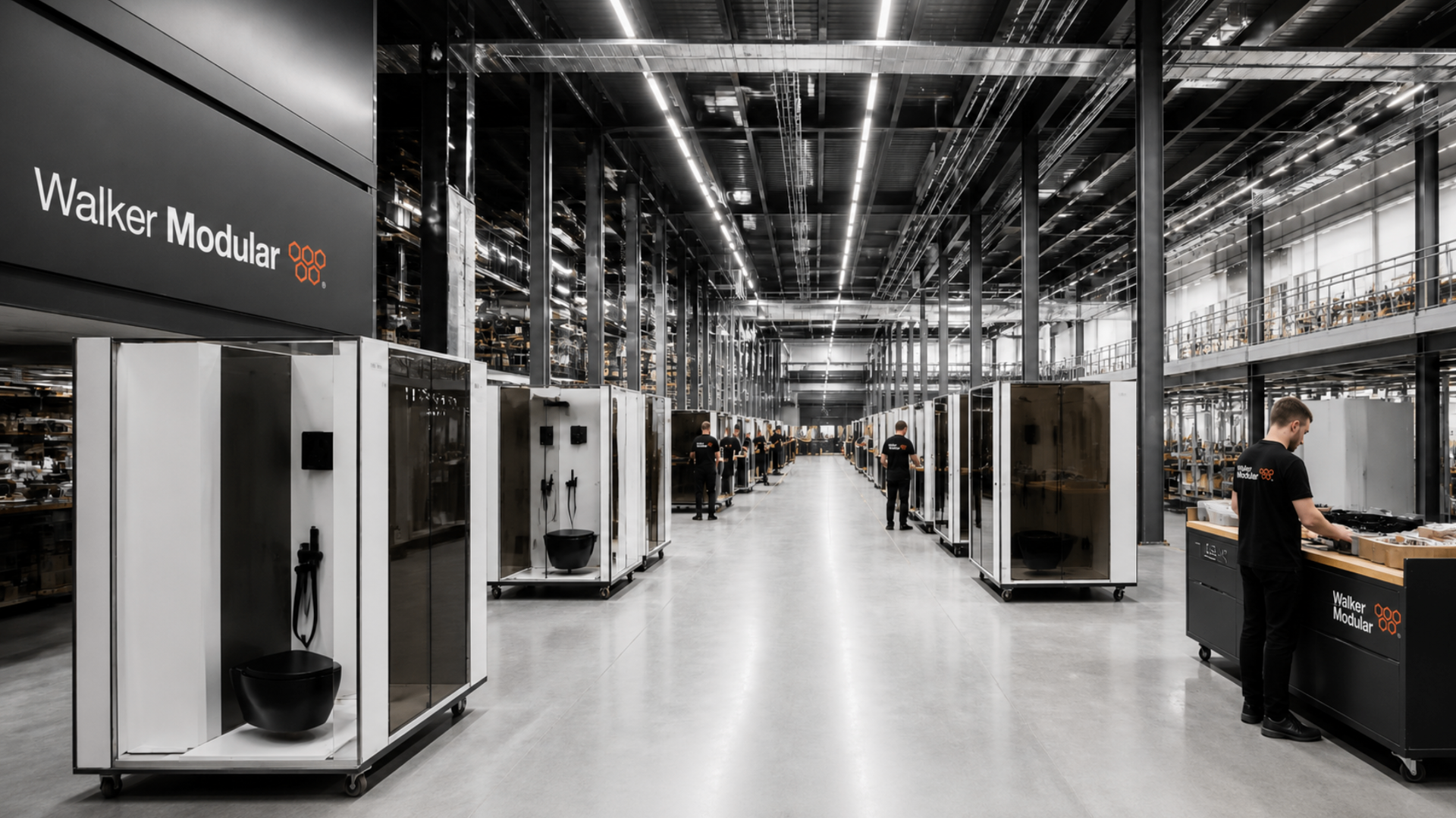
A factory does not remove craftsmanship from the bathroom. It gives craftsmanship a controlled environment in which to become repeatable.
Three principal bathroom pod construction systems
Steel framed. One-piece GRP. Assembled panel GRP. Three approaches to bathroom pod construction — with very different engineering principles.
The phrase "bathroom pod" does not describe one universal construction method. Two pods can arrive on the same lorry, present a similar finished bathroom, and be engineered on fundamentally different principles.
A buyer should understand not simply whether a bathroom is manufactured as a pod, but how the waterproof enclosure and structure are actually constructed. That single question tells you more about long-term risk than almost anything else in the tender.
Walker Modular manufactures steel framed tiled bathroom pods and one-piece seamless GRP bathroom pods. Walker Modular does not manufacture assembled panel GRP bathroom pods.
Manufactured by Walker Modular
Steel framed tiled
- Engineered steel structure
- Conventional tiled finishes
- High design flexibility
- Factory tanking and fit-out
Manufactured by Walker Modular
One-piece GRP
- Integrated moulded enclosure
- Integral floor/wall relationship
- Reduced joint count
- High-repetition manufacture
Not manufactured by Walker Modular
Assembled panel GRP
- Separate panels and floor
- Panel-to-panel junctions
- Additional sealed interfaces
- More details to inspect
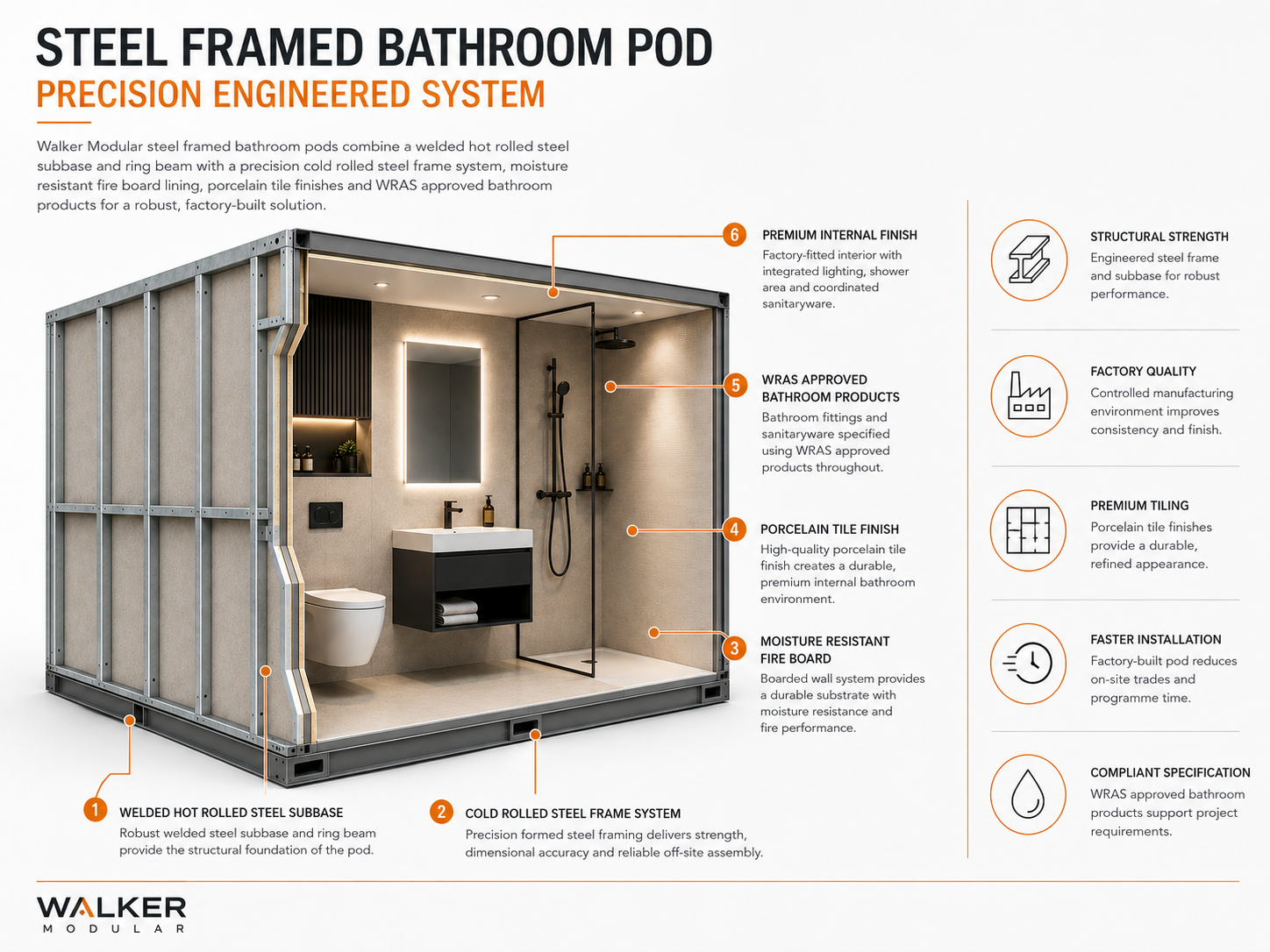
Steel framed tiled bathroom pods
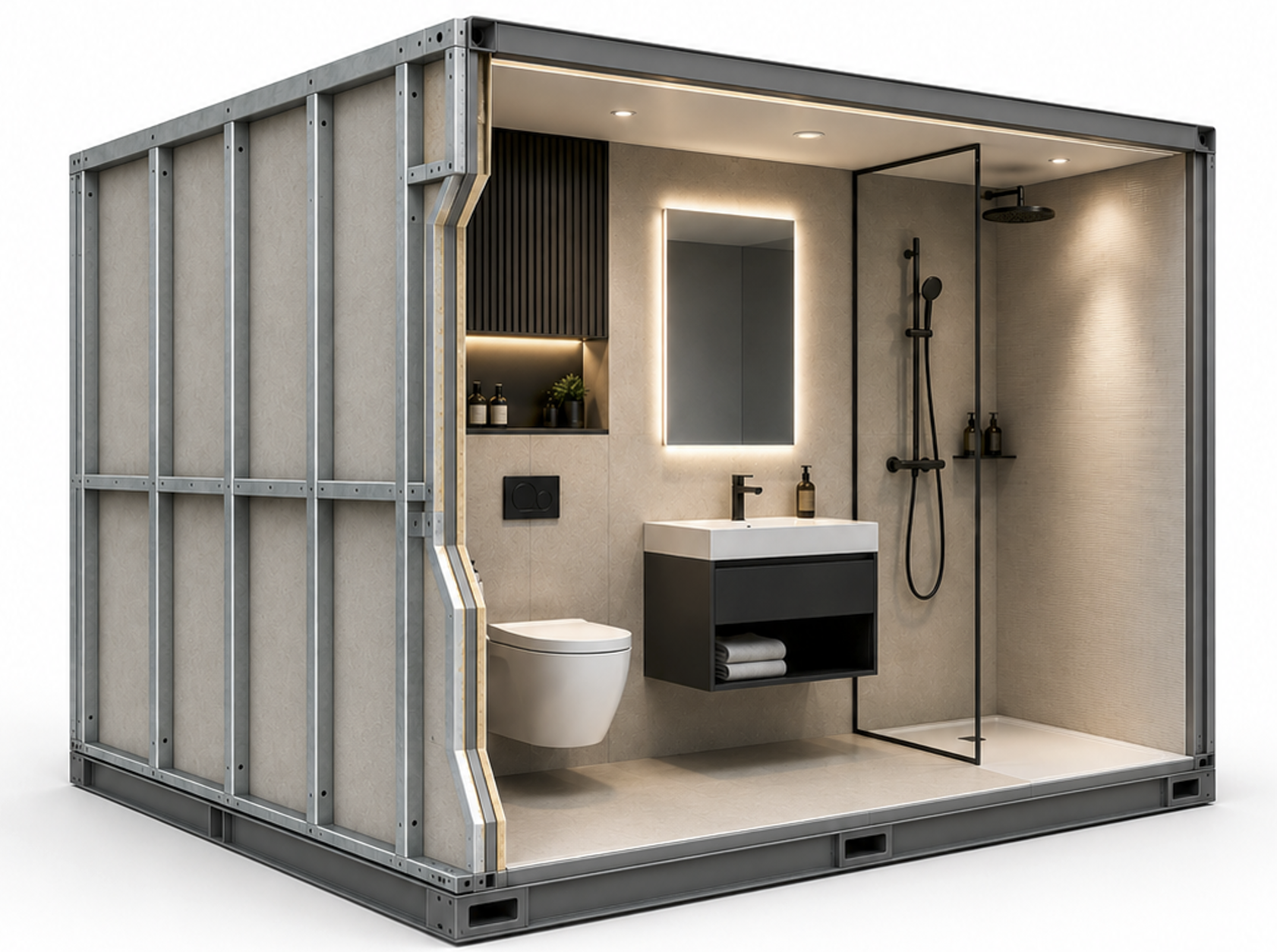
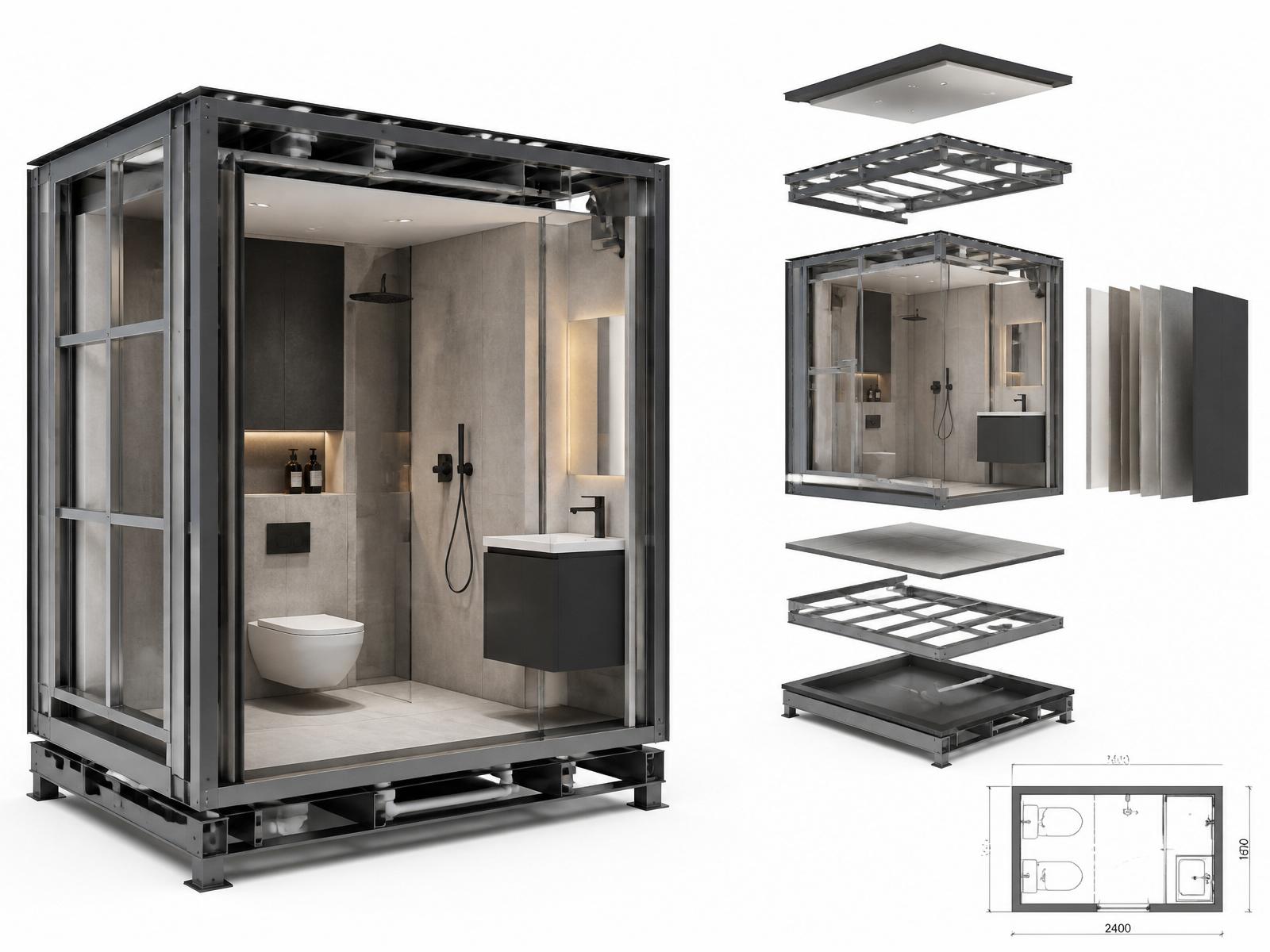
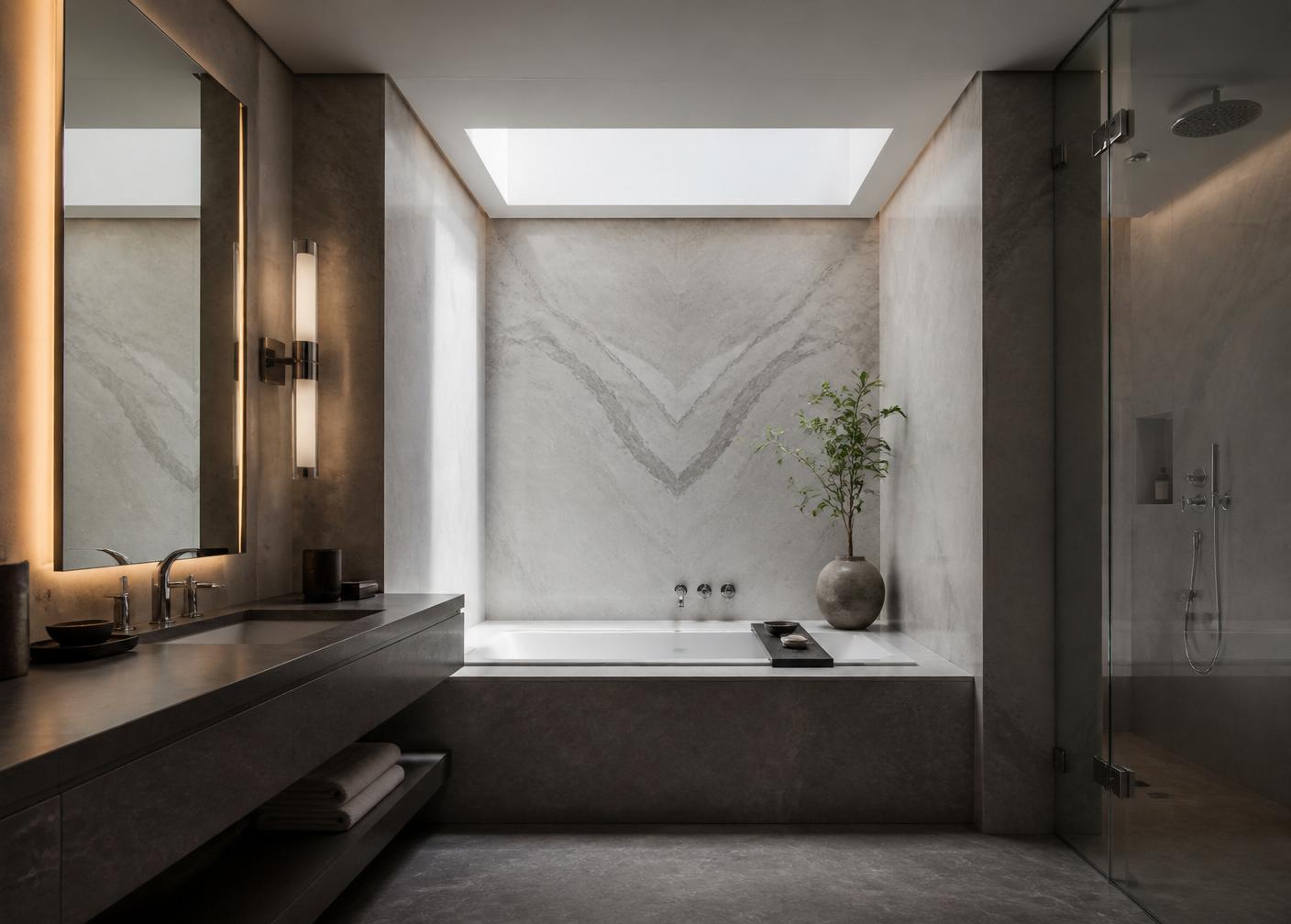
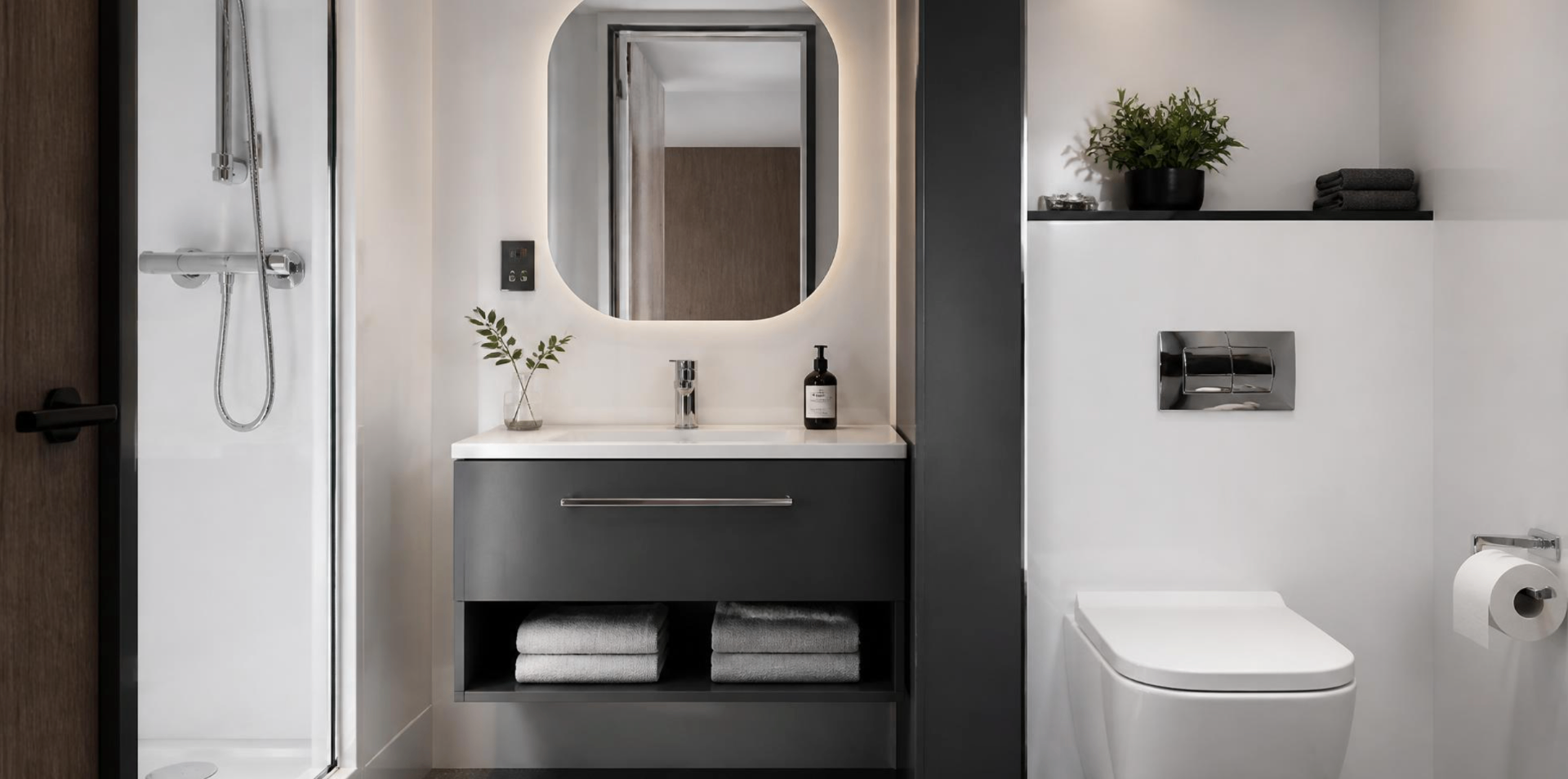
Steel framed tiled bathroom pods are built around an engineered steel structure carrying a conventionally finished, fully tiled interior. They are particularly suitable where clients expect a conventional tiled appearance, premium finishes, familiar residential aesthetics, architectural flexibility, design customisation and engineered structural construction.
Traditional look. Manufactured precision.
For housebuilders in particular, this is the most straightforward route into manufactured bathrooms, because nothing about the customer-facing product has to change.
Keep the bathroom your customer expects. Change the way it is built.
- Engineered steel structure designed for transport, lifting and installation
- Controlled factory tanking applied under stable conditions
- Factory-installed tiles and wall finishes
- Factory-installed sanitaryware
- Factory-installed brassware
- Repeatable QA at every defined production stage
- Digital traceability for each individual pod
- Reduced onsite trade interfaces
- Controlled production conditions independent of site weather
Read more
One-piece seamless GRP bathroom pods
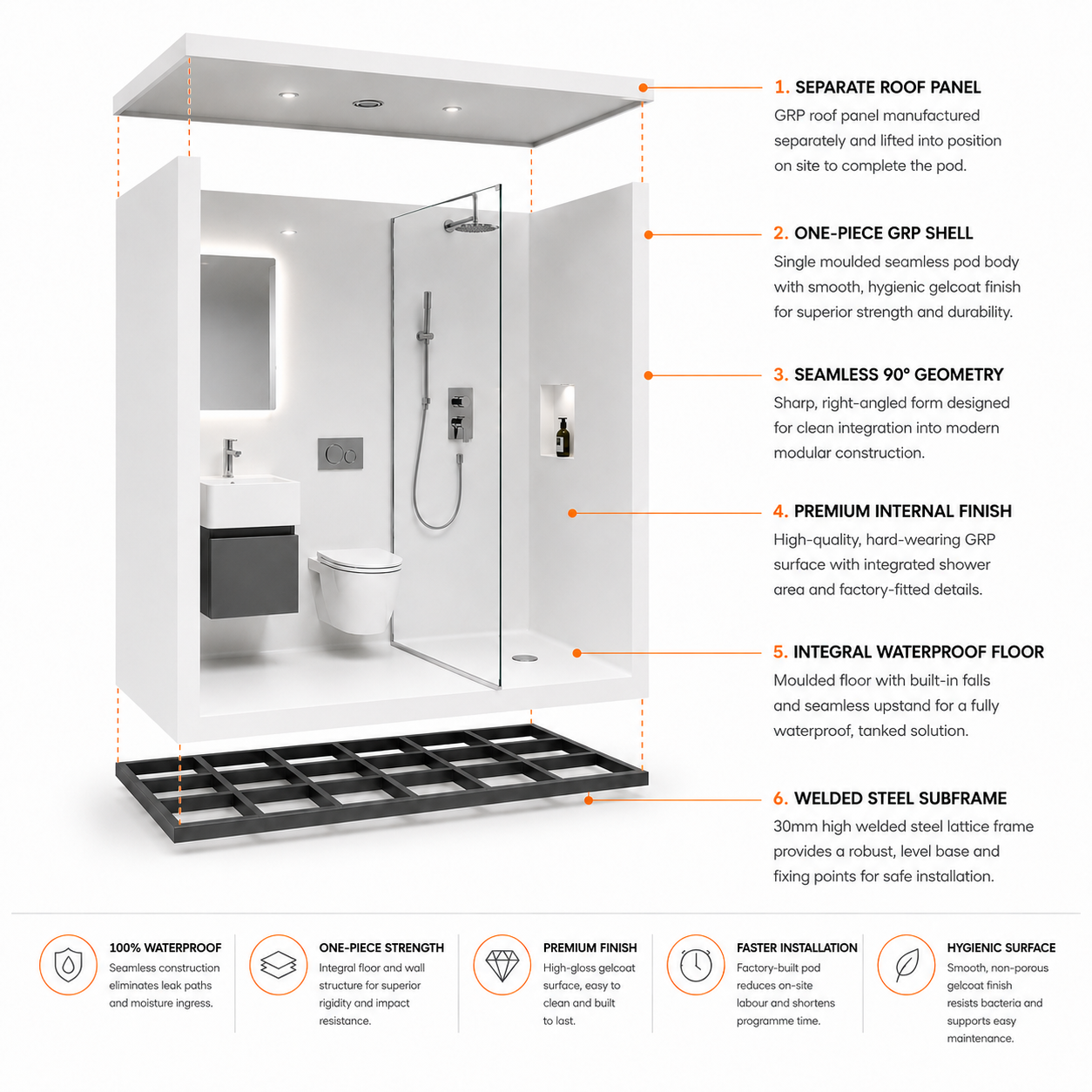
Walker Modular's GRP system uses an integrated moulded enclosure. Rather than joining separate elements together to create a watertight box, the enclosure is formed so that the floor and wall relationship is integral to the structure itself.
- Integrated moulded enclosure
- Integral floor-to-wall relationship
- Reduced panel-to-panel joints
- Reduced dependence on sealed interfaces
- High repeatability across large volumes
- Durability under intensive daily use
- Controlled, consistent geometry
- Suited to high-volume manufacture
- Factory consistency from the first pod to the last
Fewer joints. Fewer interfaces. Fewer places to manage.
It is worth being precise about where the value sits. GRP as a material is widely used across construction and marine engineering; that alone is not the advantage.
The advantage is not merely GRP. It is what one-piece GRP allows you to remove: unnecessary joints and interfaces.
Read more
Assembled panel GRP bathroom pods
Some GRP bathroom pods are created by joining separate GRP components — wall panels, floor, ceiling, corners and junction pieces — into a complete enclosure. This is a legitimate engineering approach with its own logistical and commercial advantages, and it is used widely.
The important point for a buyer is that those components must then be assembled into a complete waterproof enclosure. Depending on the system, the interfaces may involve sealants, adhesives, bonded joints, gaskets, mechanical connections or other waterproofing details.
A panel system can be successfully engineered, but every additional joint becomes another detail that must be designed, manufactured, inspected and maintained correctly.
The material may be similar. The construction philosophy is not.
One-piece GRP and panel GRP are not the same thing
Buyers often hear "GRP bathroom pod" as though it describes one product technology. It does not. Two pods can both be accurately described as GRP and be constructed on entirely different principles.
A one-piece moulded GRP pod and an assembled GRP panel pod can differ significantly in joint counts, waterproofing strategy, assembly process, interface quantities, inspection requirements and long-term maintenance considerations.
One-piece GRP
One continuous moulded enclosure
- Integral moulded walls
- Integral moulded floor
- Seamless internal construction
- Minimal reliance on joints
- Factory-controlled manufacture
- Consistent moulded geometry
Assembled panel construction
Multiple components, multiple interfaces
- Separate wall panels
- Separate floor element
- Multiple component interfaces
- Panel-to-panel junctions
- Sealant-dependent connections
- More joints requiring detailing
This is why comparing tenders on material alone is misleading. The meaningful comparison is how the waterproof enclosure is formed, how many interfaces its performance depends upon, and how each of those interfaces is inspected before it is concealed.
GRP or steel framed — which Walker system is right?
Walker Modular manufactures both systems. That matters commercially, because it means the product can be selected around the project's requirements rather than the manufacturer's single technology being fitted to every project.
The right question is not which system is universally better. It is which manufactured bathroom system best fits the project.
| Steel framed tiled bathroom pods | One-piece GRP bathroom pods |
|---|---|
| Traditional tiled aesthetics are required | High repetition across the scheme |
| Finish flexibility matters to the design team | Large volumes and sustained output |
| Housebuilders want familiar customer-facing bathrooms | Durability under intensive use is critical |
| Premium residential or guest-facing finishes | Reduced waterproofing interfaces are attractive |
| Architectural choice is important | Repeatability and consistency dominate |
Mixed schemes are common. A repeated core bathroom type in GRP can sit alongside steel framed pods for accessible, feature or premium rooms within the same development.
How bathroom pods are designed
Bathroom pod design is an exercise in coordination as much as in bathroom layout. The pod is a manufactured product that must integrate precisely with a building that is being constructed by other people, to other tolerances, in another location.
- Architectural layouts and room types rationalised into repeatable configurations
- Room coordination with adjacent spaces, corridors and structure
- BIM modelling and integration into the wider building model
- MEP coordination for water, waste, electrical and ventilation
- Drainage strategy, falls and connection points
- Service positions and riser relationships
- Penetrations and how they are formed and sealed
- Access for delivery, installation and future maintenance
- Door positions, swings and thresholds
- Installation interfaces with structure and floor levels
- Design freeze — the point at which manufacture can begin
- Rationalisation of room types to maximise repetition
Early involvement changes outcomes more than any other single factor. When the manufacturer is engaged early, room types can be rationalised, riser positions optimised and interfaces resolved digitally. When the manufacturer is engaged late, the pod has to absorb decisions already fixed elsewhere, and some of the available benefit is lost before manufacture starts.
Related pages
BIM and digital coordination
Digital coordination is where most bathroom pod risk is removed. Problems that would be expensive to discover on the twelfth floor are inexpensive to resolve in a model.
- Clash detection between pods, structure, services and finishes
- Service coordination across water, waste, electrical and ventilation
- Repetition — confirming that repeated room types really are repeatable
- Riser relationships and connection geometry
- Drainage routes, falls and interface points
- Interface management between manufactured and site-built elements
- Integration with the wider building information model
- Construction sequencing and installation planning
How bathroom pods are manufactured
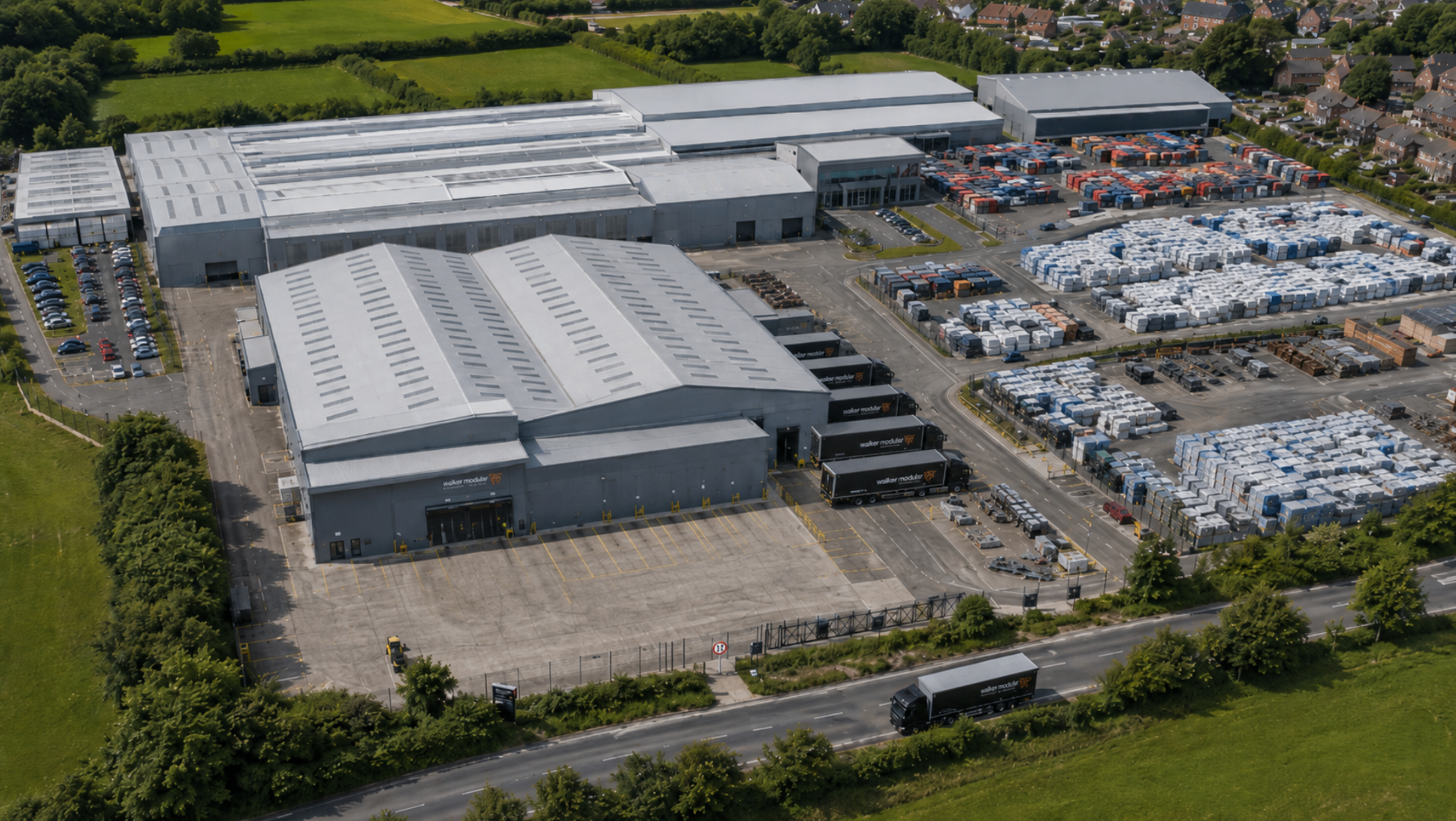
The manufacturing journey
- 01Design→
- 02Procurement→
- 03Manufacture→
- 04Waterproofing→
- 05Fit-out→
- 06Testing→
- 07QA→
- 08Delivery
Onsite construction manages variability. Manufacturing designs it out.
The value of manufacture is not simply that the work happens indoors. It is that each operation is defined, resourced, supervised and inspected in the same way every time, and that the next stage cannot begin until the previous one has been accepted.
- Controlled processes with defined inputs and outputs
- Stable working conditions independent of weather and site progress
- Consistent materials procured and stored under control
- Structured supervision at every station
- Defined manufacturing stages with clear acceptance points
- Repeatable inspection rather than ad-hoc checking
- Dedicated QA function independent of production pressure
Throughout this guide we apply a deliberate principle: explain the advantage, protect the mechanism. Walker Modular publishes what its systems achieve and how risk is controlled and inspected. It does not publish the specific methods, tooling, formulations, settings or thresholds that make those results repeatable.
Related pages
Bathroom pod waterproofing
A bathroom is one of the most demanding environments in a building. It is subject to water, steam, repeated daily use, cleaning chemicals, temperature changes, structural and thermal movement, service penetrations and concentrated wetting in shower zones — for decades.
Waterproofing performance depends on a small number of things being right, consistently: substrate preparation, the tanking system, the floor-to-wall relationship, shower interfaces, how penetrations are formed and sealed, and — critically — inspection before finishes conceal the waterproofing forever.
Walker Modular has developed controlled tanking and shower-sealing details specifically for repeatable factory manufacture and inspection.
The advantage of factory application is consistency. Preparation happens in controlled conditions rather than on a wet, cold, dusty floor. Application follows a defined process by trained people. Inspection is a formal stage with a record, not a glance before the tiler arrives. And because the same detail is produced hundreds of times a week, deviation becomes visible immediately.
In line with our principle, this guide does not publish tanking build-ups, shower-sealing geometry, proprietary methods or step-by-step application procedures. What matters to a buyer is not the recipe but the control: how the detail is designed, how consistently it is applied, how it is verified and what evidence exists afterwards.
Why joints matter in a wet environment
Where a waterproof enclosure is created by connecting separate components, each junction becomes part of the waterproofing system. It must be designed correctly, prepared correctly, sealed correctly, inspected correctly, able to accommodate movement, and maintained appropriately over the life of the building.
General failure mechanisms in wet enclosures are well understood across the industry, and none of them are unique to bathroom pods. They include sealant ageing, movement, inadequate substrate preparation, inconsistent application, mechanical damage to joints, corner detailing, penetrations, shower interfaces, wall-to-floor junctions and hidden water migration behind finishes.
Water does not need a large defect. It only needs one weak interface.
This is not an argument that all panel pods leak, or that any particular sealing material fails. Well-engineered panel systems perform, and sealants perform when correctly specified, applied and maintained. The argument is statistical rather than absolute.
The more interfaces a waterproof enclosure contains, the more interfaces have to continue performing correctly.
Reducing unnecessary interfaces reduces the number of locations whose performance depends upon a joint. That is the engineering logic behind Walker Modular's one-piece GRP enclosure, and behind the controlled, inspected tanking approach used in its steel framed tiled bathroom pods.
An analogy, carefully drawn
Would you rather cross the water in a hull formed as one continuous moulding, or one assembled from multiple panels whose watertightness depends on every joint?
This is an analogy about construction philosophy, not an assertion that every panel-built bathroom will leak. Plenty of assembled structures are entirely watertight. The point is simply where the risk sits, and how many places have to keep performing for the enclosure to remain sound.
Bathroom pod floors
The floor is where structure, waterproofing and installation all meet, which makes it one of the most consequential parts of any bathroom pod design.
- Structural integration with the building's floor construction
- Waterproofing continuity across the floor plane
- The floor-to-wall relationship, where most wet-zone risk concentrates
- Shower integration, falls and drainage
- Thresholds and level transitions at the doorway
- Installation interfaces, tolerances and setting-out
Walker Modular offers both floored and floorless approaches depending on the project's structural and level requirements. Floored pods carry their own integrated floor construction; floorless arrangements are used where the pod is set to interface directly with the building's floor construction. Which is appropriate depends on structural zone, level coordination and the wider building design — and it is a decision best taken early. Detailed floor build-ups are not published.
Materials
Manufactured production allows material systems to be selected deliberately and then installed the same way every time. Specification decisions are considered against durability, water resistance, compatibility between adjacent materials, maintenance and cleaning regimes, appearance, supply consistency and repeatability across the programme.
Supply consistency deserves particular attention on long programmes. A tile, a tray or a brassware range that is available today may not be available in the same batch or finish in eighteen months. Manufactured production plans this into procurement rather than discovering it plot by plot.
Consistency is not simply selecting the right material. It is ensuring the right material is installed the right way, every time.
Quality assurance
There is a meaningful difference between checking quality at the end and building quality into the process. Final inspection can only find what has already happened. Stage inspection prevents the defect from being concealed in the first place.
- Stage inspections tied to defined production milestones
- Factory testing before dispatch
- Process control rather than individual judgement
- Photographic evidence captured at critical points
- Structured defect management and root-cause correction
- Final inspection of the completed bathroom pod
- Formal release for delivery — no release, no dispatch
The most important inspections in a bathroom pod happen before anything visible is installed. Once tiles, trays and finishes are in place, the waterproofing that matters most is no longer accessible. That is why the inspection sequence, not the final walk-round, is the real measure of a manufacturer's quality regime.
Related pages
Digital QA and the golden thread
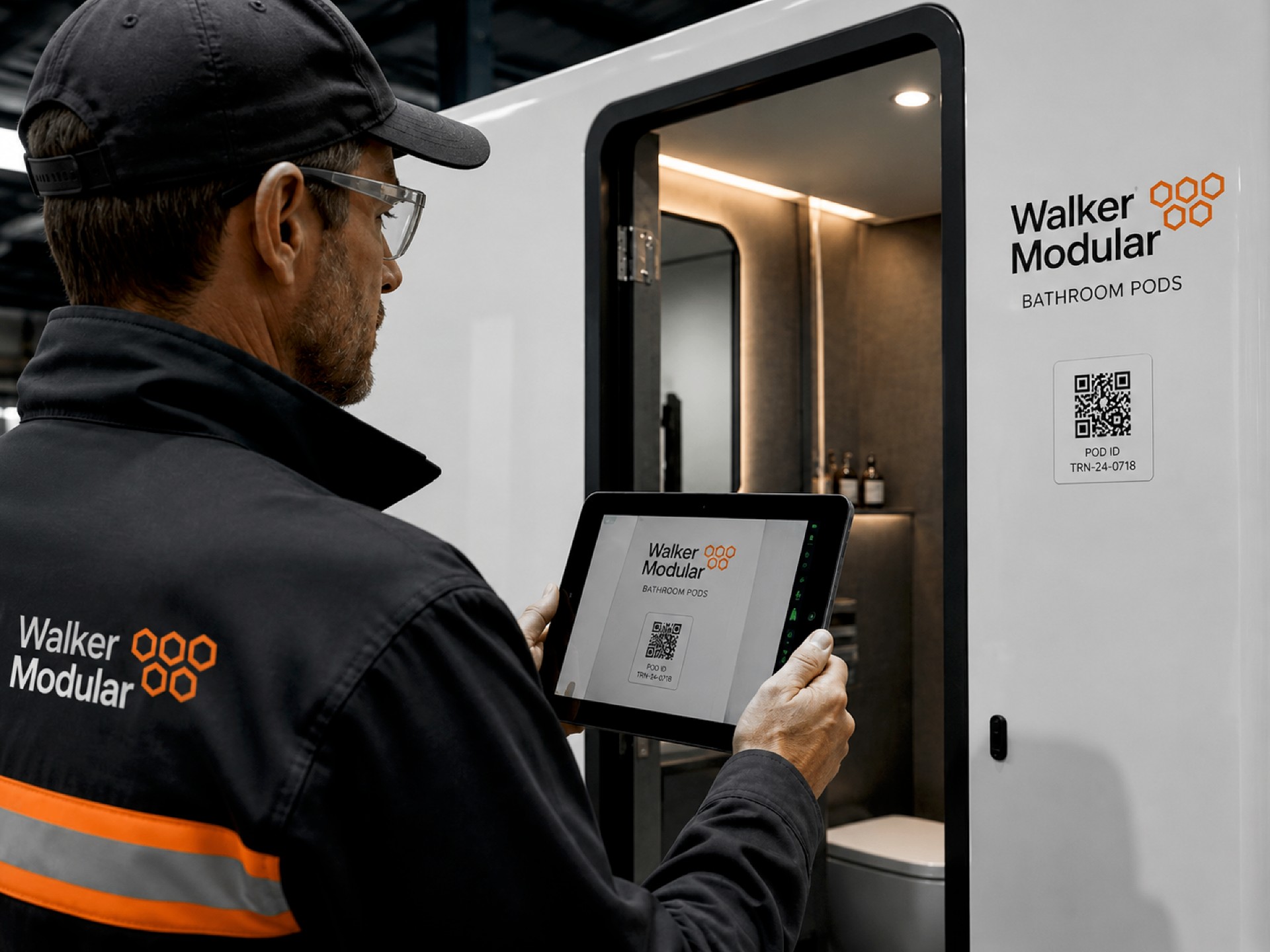
Walker Modular operates a digital quality assurance approach in which each bathroom pod carries its own identity and record through manufacture.
- Unique identification for every individual bathroom pod
- Inspection history against defined production stages
- Photographic records of critical points before concealment
- QA records held against the pod, not the batch
- Traceability from raw components to the installed room
- Client visibility of progress and quality evidence
- Structured handover information at completion
Every pod traceable. Every check recorded.
The wider construction industry's move towards better information management makes this increasingly valuable to asset owners, because it means the record of what was built and checked exists as a by-product of manufacture rather than as a document assembled at handover.
Factory testing
Bathroom pods can be inspected and tested before they leave the factory. At a high level this typically covers visual inspection of the completed room, functional checks of installed components, plumbing and water-related checks, electrical checks where applicable, verification of sanitaryware and brassware installation, finish inspection, and formal QA release.
Specific test procedures, parameters and acceptance thresholds are part of Walker Modular's controlled quality system and are shared with clients under project arrangements rather than published.
Crucially, factory testing verifies the pod as a manufactured product. It does not, and cannot, verify the building services it has not yet been connected to.
Factory complete does not mean site checks disappear
Once a bathroom pod is positioned and connected to the building's permanent services, appropriate site-side inspection, testing and commissioning remain necessary. Any manufacturer suggesting otherwise is overselling.
Manufactured complete. Connected, tested and commissioned as part of the building.
Water
- Final water connections to the permanent supply
- Leak checks at connections and interfaces
- Pressure testing where appropriate to the design
- Functional testing of outlets and showers
Waste and drainage
- Final waste connections
- Functional discharge checks
- Verification of the interface with building drainage
Electrical
- Final electrical connections
- Inspection and testing by appropriately competent persons
- Functional testing of installed electrical components
- Certification where required by the project and applicable standards
Other M&E and commissioning
- Ventilation where applicable
- Building-service interfaces such as heating and controls
- Commissioning within the wider building systems
- Project inspection and sign-off
The final installed bathroom and its building-service connections must be appropriately inspected, tested and commissioned in accordance with the applicable regulations, standards and project requirements before being brought into service.
None of this undermines the plug-and-play proposition. It clarifies it. What manufacture removes is the construction of the bathroom — the sequential trades, the waterproofing, the tiling, the fit-out and the snagging that follows them.
Walker Modular removes the complexity of building the bathroom. The site team is left primarily with controlled connection, testing and commissioning.
Manufacture the bathroom in the factory. Connect and commission it as part of the building.
Delivery and logistics
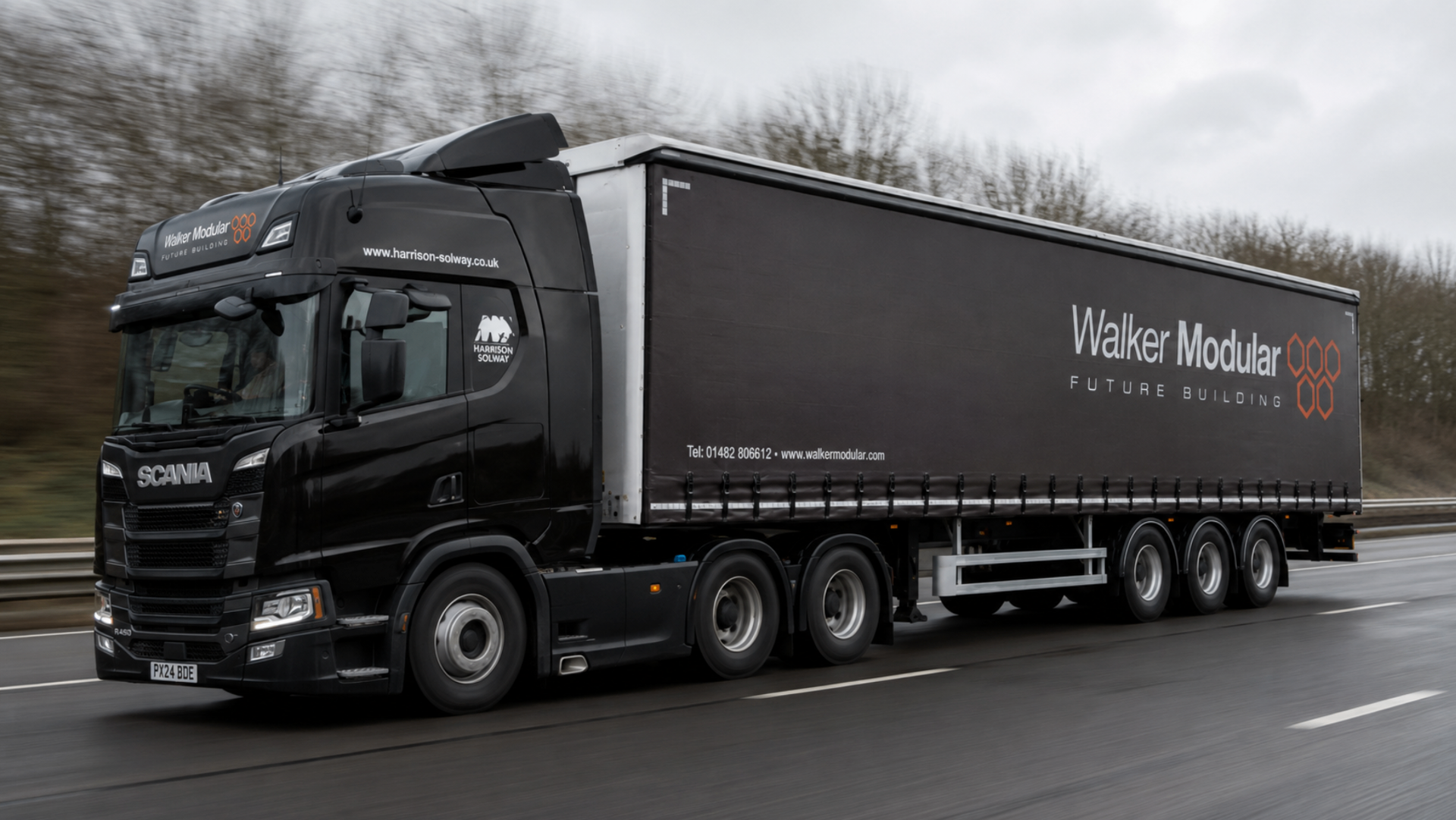
A finished bathroom is a valuable, damage-sensitive product, and logistics is a genuine part of the engineering rather than an afterthought.
- Protection of finishes, sanitaryware and openings in transit
- Transport planned around access, route and vehicle type
- Sequencing aligned to the installation programme
- Delivery planning coordinated with the main contractor
- Storage arrangements where site conditions require them
- Lifting method agreed in advance with the project team
- Positioning and setting-out at the point of installation
- Ongoing coordination as the programme moves
Manufacture while you build. Deliver when you need it.
Installation
Installation sequence
- 01Deliver→
- 02Position→
- 03Connect→
- 04Test→
- 05Commission→
- 06Complete
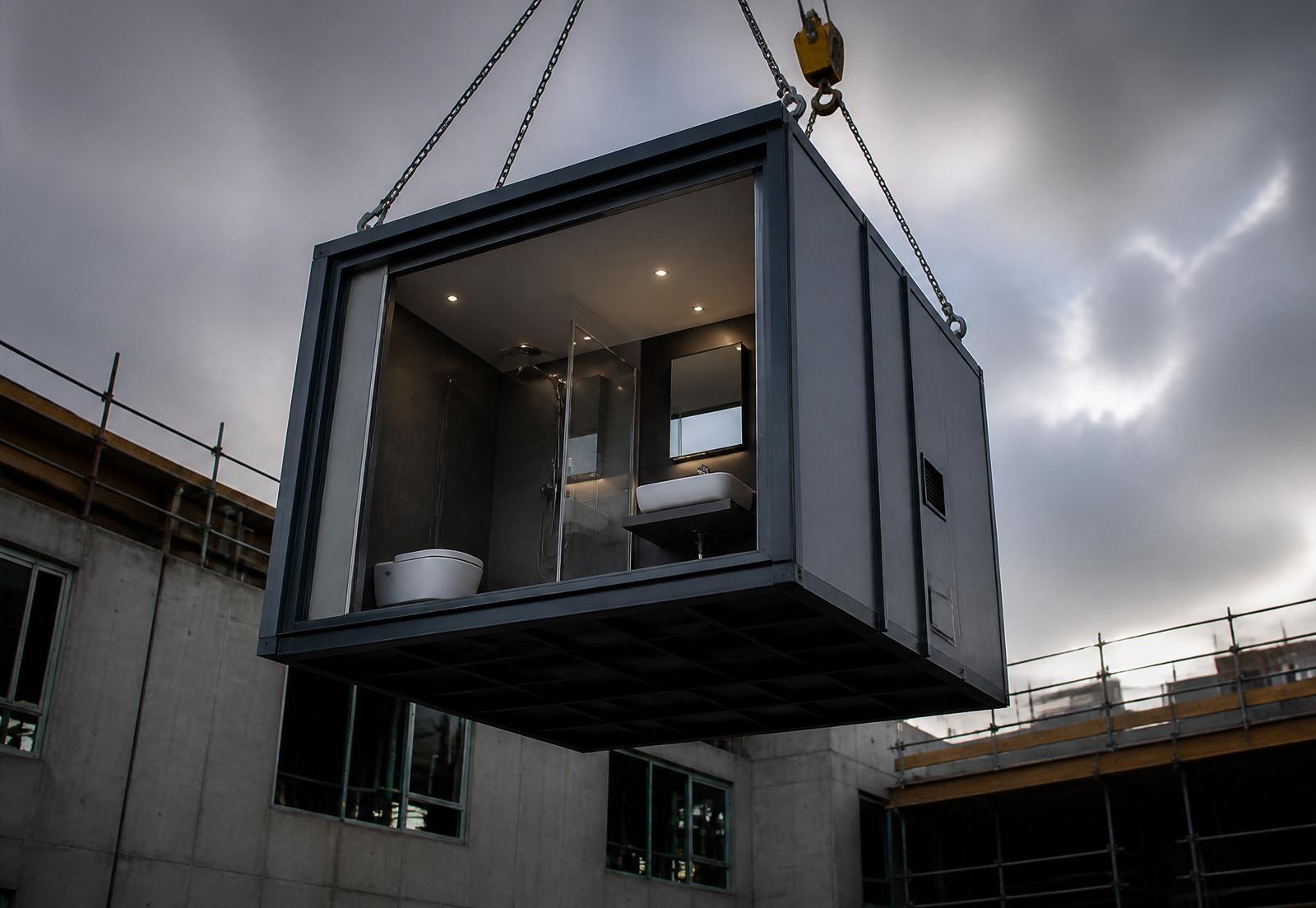
At a high level, pods are delivered in sequence, moved or lifted into position, set out against the structure, connected to permanent services, then tested and commissioned as part of the building. Lifting and installation methodology is project-specific, safety-critical and agreed with the main contractor and appropriate specialists — it is not something to be generalised in a guide.
Programme benefits
The core programme advantage is parallelism. Bathroom pod manufacture proceeds while the building is being constructed, so bathroom production is no longer waiting for the structure to be ready.
- Fewer bathroom-specific sequential trades onsite
- Reduced number of programme interfaces to manage
- Improved predictability of bathroom completion
- Deliveries coordinated to the installation sequence
- Reduced dependence on weather during fit-out
- Reduced late-stage bathroom completion risk near handover
The size of that benefit depends entirely on the project, the design coordination and how early the manufacturer is engaged. Any manufacturer quoting a universal programme saving percentage should be asked how it was measured.
The cheapest bathroom is not necessarily the lowest-cost bathroom to deliver
Traditional bathroom construction is usually priced on visible direct costs: materials and labour. Those are real, but they are not the complete cost of getting a finished, defect-free bathroom handed over.
Visible above the line
- Materials
- Labour
Below the line
- Coordination between multiple trades
- Site supervision and management time
- Multiple visits and repeated mobilisations
- Material handling, storage and protection
- Waste generated and removed
- Damage during following trades
- Rework and remedial work
- Snagging at the most sensitive point in the programme
- Programme delays and their knock-on effects
- Warranty and defect-period exposure
This guide does not attach numbers to those lines, because the numbers are project-specific and any generic figure would be invented. The useful exercise is to price your own: take a completed development and ask how much management time, remedial work and warranty attention the bathrooms actually consumed.
Traditional onsite vs manufactured bathroom pod
Traditional onsite bathroom
- 01Multiple trades
- 02Sequential operations
- 03Waterproofing
- 04Tiling
- 05Sanitaryware
- 06Finishing
- 07Testing
- 08Snagging
- 09Remedials
Walker manufactured bathroom
- 01Design
- 02Manufacture
- 03QA
- 04Test
- 05Deliver
- 06Position
- 07Connect
- 08Commission
Fewer interfaces. Fewer dependencies. Greater certainty.
Plug and play is a fair description of the site experience, provided it is understood correctly: the bathroom arrives built, and the site scope becomes connection, testing and commissioning. Fit and forget describes the intent behind durable, well-detailed manufactured bathrooms — though like any part of a building, a bathroom still requires appropriate cleaning, maintenance and periodic attention over its life.
Bathroom pod procurement
Procuring bathroom pods is not the same as procuring a material package. You are transferring a significant, quality-sensitive part of the building into someone else's factory, on your critical path.
- Design capability and willingness to engage early
- Manufacturing capability across the systems you need
- Factory ownership and direct control of production
- Product technology — how the enclosure is actually constructed
- Relevant experience in your sector and at your scale
- Waterproofing approach and how it is inspected
- QA systems and the evidence they produce
- Digital traceability and handover information
- Manufacturing capacity relative to your peak demand
- Procurement strength and supply chain control
- Financial resilience over the life of the programme
- Programme support and responsiveness to change
- Logistics capability into live construction sites
- Warranty position
- Aftercare and long-term support
Questions to ask a bathroom pod manufacturer
These are neutral questions. Any capable manufacturer should welcome them, and the quality of the answers usually says more than the sample pod in reception.
- Which bathroom pod systems do you manufacture?
- Is the GRP enclosure one-piece or assembled from panels?
- How is waterproofing controlled through production?
- How many primary enclosure interfaces does the system contain?
- How are joints and interfaces inspected before concealment?
- What QA evidence is retained, and can we see it per pod?
- What testing takes place before delivery?
- What testing and commissioning remains onsite?
- What is your manufacturing capacity, and what is already committed?
- Can we visit the factory during live production?
- How are defects identified, controlled and prevented from recurring?
- What project experience do you have in our sector and at our scale?
- How early must design start, and what do you need from us?
- How financially resilient is the business behind the programme?
- What happens if our programme requirements change?
- What warranty and aftercare support is available after handover?
Manufacturing capacity
Capacity matters because a bathroom pod order is a promise about a date. Walker Modular's Main Factory manufactures 1,000+ bathroom pods per week, with Factory 2 producing a further 500 bathroom pods per week — combined manufacturing capacity of more than 1,500 bathroom pods per week.
What a buyer should take from any capacity figure is not the number itself but the headroom behind it: whether the manufacturer can absorb your peak alongside existing commitments, and what happens to your programme if another client's does not go to plan.
Related pages
A manufacturing partner has to stand behind the programme
Moving a critical package into factory manufacture requires confidence in the business as well as the product. The pod arrives in eighteen months; the warranty runs for far longer.
- Manufacturing infrastructure that is owned and controlled
- Procurement capability across a long supply chain
- Financial resilience through economic cycles
- Experienced teams with genuine delivery history
- Investment capability in plant, systems and people
- Long-term stability rather than project-by-project capacity
- Established quality systems that outlive individual contracts
- Programme support when circumstances change
A bathroom pod is only as dependable as the manufacturer standing behind it.
Walker Modular has manufactured bathroom pods since 2006 and has delivered over 250,000 pods across the UK — a history of sustained investment, established production capacity and repeat delivery for major developers and contractors.
Related pages
Housebuilding
Housebuilding deserves particular attention, because it is the sector where the objection to manufactured bathrooms is most often aesthetic rather than technical. The concern is that a manufactured bathroom will look manufactured. With steel framed tiled bathroom pods, it does not.
Keep the bathroom your customer expects. Change the way it is built.
Major housebuilders can retain the familiar tiled interiors, the customer-facing finishes and the existing aesthetic expectations that support their brand and their sales, while changing the production model from repeated onsite bathroom construction to controlled factory manufacture.
What the homeowner sees
- A conventional, fully tiled bathroom
- Familiar finishes and sanitaryware
- The specification the purchaser was shown
- No visible sign of manufacture
What protects the housebuilder
- Engineered steel structure
- Controlled, inspected tanking
- Factory-installed services and finishes
- Stage QA and a traceable record per pod
The strategic question for a housebuilder is straightforward: why recreate the same bathroom construction process plot after plot when it can be manufactured repeatedly under controlled conditions?
Other sectors
Hotels
Hotels combine high repetition with an unforgiving guest-facing standard. Consistent finishes across every key, programme certainty for an opening date, and operational reliability over years of intensive use all favour manufactured bathrooms.
Student accommodation (PBSA)
PBSA schemes are typically high volume with highly repeated room types, extremely demanding durability requirements and immovable academic-year completion dates. Repeatability and programme certainty are decisive.
Build to Rent
BTR developers hold the asset, so whole-life ownership dominates. Consistency between apartments, maintainability, documented quality assurance and predictable component replacement all matter as much as the delivery programme.
Residential
Wider residential development benefits from finish flexibility combined with scale and repeatability — different bathroom types across a scheme, each manufactured consistently.
Healthcare
Healthcare environments demand controlled quality, cleanability, traceability of what was installed and repeatability across wards and floors — all natural strengths of a controlled manufacturing process.
Sustainability
Manufactured bathrooms create the conditions for better environmental performance, though the benefit comes from the manufacturer's systems rather than from the concept alone.
- Controlled material usage against defined quantities
- Managed factory waste streams rather than mixed site skips
- Reduced bathroom-related waste generated on site
- Consolidated logistics instead of repeated small deliveries
- Factory efficiency in energy and material handling
- Repeatability, which reduces error, rework and scrap
- Product longevity, which is the most fundamental sustainability measure of all
Related pages
Maintenance and whole-life considerations
For asset owners, the interesting question is not how the bathroom is delivered but how it behaves for the next twenty to forty years.
- Maintenance access to services, valves and connections
- Component replacement without disturbing the waterproof enclosure
- Durability of surfaces under cleaning and intensive use
- Long-term waterproofing performance and where risk concentrates
- Defect exposure during and after the defects liability period
- Long-term ownership costs across a portfolio
- Warranty position on structure and installed components
- Repeatability of replacement parts across a repeated room type
Repeatability is quietly valuable here. When a thousand bathrooms are genuinely identical, maintenance teams learn one bathroom, hold one set of spares and repeat one intervention.
Warranty and aftercare
A serious bathroom pod manufacturer should offer a clear warranty position, a defined support route after handover, and records that make any future intervention straightforward. Walker Modular provides a 40-year structural warranty on the pod structure, alongside its published aftercare arrangements.
Related pages
When bathroom pods make sense
- Bathrooms are repeated across the development
- Quantities are substantial
- Room types are predictable and can be rationalised
- The programme is under pressure or has a fixed completion date
- Design coordination is strong and can support a design freeze
- Site labour availability is constrained
- The scheme is a major or multi-phase programme
When bathroom pods may not be right
Credibility requires saying this plainly: bathroom pods are not the answer to every project.
- Every bathroom in the scheme is genuinely unique
- Quantities are extremely small
- Design remains unresolved until very late in the programme
- Delivery routes, access or crane provision cannot accommodate pods
- Dimensional or structural interfaces cannot be coordinated in time
Where those conditions apply, a manufacturer worth working with will say so early rather than force the project into a product that does not fit it.
What should you look for during a bathroom pod factory visit?
A factory visit is the single most informative hour in bathroom pod procurement — provided you look at production rather than the showroom.
- Production organisation — is there a defined flow, or improvisation?
- Material control — how components are stored, protected and issued
- Factory cleanliness, particularly in waterproofing areas
- Structural manufacture and its consistency
- Waterproofing discipline and when it is inspected
- QA stations, records and the independence of the QA function
- Testing arrangements before release
- Digital records — ask to see the history of a specific pod
- Finished-product consistency across several completed pods
- Manufacturing scale relative to your programme
- Workforce stability and supervision
- Logistics, loading and protection arrangements
Bathroom pods: frequently asked questions
What is a bathroom pod?
A bathroom pod is a factory-manufactured bathroom that is substantially completed before it is delivered to site. Depending on the system and specification it can include the structure, waterproofing, wall finishes, flooring, shower, sanitaryware, brassware, electrical components, accessories, testing and quality assurance records.
What is a modular bathroom pod?
Modular bathroom pod, manufactured bathroom pod and prefabricated bathroom pod are used broadly interchangeably in the UK market. They all describe a bathroom produced as a controlled manufactured product rather than assembled in place from separate trades.
What are the three main bathroom pod construction systems?
Steel framed tiled bathroom pods, one-piece moulded GRP bathroom pods and assembled panel GRP bathroom pods. Walker Modular manufactures steel framed tiled bathroom pods and one-piece seamless GRP bathroom pods. Walker Modular does not manufacture assembled panel GRP bathroom pods.
What is the difference between one-piece GRP and panel GRP?
A one-piece GRP pod uses an integrated moulded enclosure in which the floor and walls form a continuous structure. A panel GRP pod is assembled from separate components — wall panels, floor, corners and junction pieces — which must be joined into a complete waterproof enclosure. The material may be similar; the construction philosophy is not.
What is a steel framed bathroom pod?
A bathroom pod built around an engineered steel structure and finished conventionally, typically with full tiling. It presents to the end user as a traditional bathroom while being manufactured, waterproofed, fitted out, inspected and tested in a factory.
Are bathroom pods fully finished?
Bathroom pods are typically delivered substantially complete, including finishes, sanitaryware and brassware, so that the site scope becomes positioning, connection, testing and commissioning rather than construction. The exact scope is agreed at specification stage.
Are bathroom pods waterproof?
Bathroom pods are designed as waterproof enclosures, with tanking and shower detailing applied and inspected under factory conditions before finishes conceal them. The performance of any wet enclosure depends on how the waterproofing is designed, applied, inspected and maintained.
How are bathroom pods manufactured?
Through defined production stages: design and coordination, procurement, structural manufacture, waterproofing, fit-out, testing, quality assurance and release for delivery. Each stage has its own inspection point, so quality is built into the process rather than checked only at the end.
How are bathroom pods installed?
Pods are delivered protected and to programme, lifted or moved into position, connected to permanent building services, then tested and commissioned as part of the building. Installation planning, lifting method and sequencing are coordinated with the main contractor.
How are bathroom pods connected?
Via defined interfaces for water supply, waste and drainage, electrical supply and, where applicable, ventilation. Positions are coordinated in design and BIM so that connection onsite is a controlled, repeatable operation.
What onsite testing is required?
Once connected, the installed bathroom and its building-service connections require appropriate inspection, testing and commissioning — typically covering water connections and leak checks, waste and drainage discharge, electrical inspection and testing by competent persons, ventilation where applicable, and project sign-off in line with the applicable regulations, standards and project requirements.
Do factory tests replace site commissioning?
No. Factory testing verifies the pod as a manufactured product before dispatch. Site-side inspection, testing and commissioning remain necessary once the pod is connected into the building's permanent services.
What services need connecting onsite?
Usually hot and cold water, waste and drainage, electrical supply and — depending on design — mechanical ventilation and any building-service interfaces such as heating or controls.
Can bathroom pods be customised?
Yes. Steel framed tiled pods in particular support a wide range of tiles, finishes, sanitaryware and layouts. Customisation is most valuable when it is defined early, before design freeze, so it can be manufactured repeatedly rather than resolved room by room.
Are bathroom pods suitable for houses?
Steel framed tiled bathroom pods are well suited to housebuilding because they retain the conventional tiled bathroom a purchaser expects while changing how it is produced. Suitability depends on repetition, access, delivery routes and design coordination.
Are they suitable for hotels?
Hotels are one of the most established bathroom pod sectors. High repetition, consistent guest-facing finishes and programme certainty all align well with manufactured bathrooms.
Are they suitable for PBSA?
Student accommodation is a strong fit: very high volumes, highly repeated room types, demanding durability requirements and tight programmes.
Are they suitable for BTR?
Build to Rent developers retain the asset long term, so consistency, maintainability, durability and documented quality assurance matter as much as delivery — all areas where manufactured bathrooms perform well.
How early should bathroom pod design begin?
As early as practical. Bathroom pods reward early involvement because layouts, riser positions, drainage, service routes and structural interfaces need to be coordinated before design freeze and the start of manufacture.
What does BIM coordination involve?
Integrating the pod model into the wider building model so that clashes, riser positions, drainage falls, service routes, penetrations and installation interfaces are resolved digitally before manufacture begins.
Why do joints matter in bathrooms?
Every joint in a wet enclosure is an interface whose performance must be designed, prepared, sealed, inspected and maintained correctly, and which must accommodate movement over time. Reducing unnecessary interfaces reduces the number of locations whose performance depends on a joint.
How should clients compare bathroom pod suppliers?
Look past the sample pod. Compare product technology and joint counts, waterproofing control, QA systems and evidence, digital traceability, factory ownership and capacity, relevant sector experience, logistics capability, financial resilience, warranty and aftercare.
How does manufacturing reduce reliance on site trades?
It moves much of the bathroom work into an established production environment where trained teams carry out defined operations repeatedly. Skilled people remain essential onsite for installation, connection, testing and commissioning, but the number of separate bathroom trade interfaces is reduced.
What manufacturing capacity should buyers look for?
Enough capacity to absorb the peak of your programme alongside the manufacturer's other commitments. Walker Modular's Main Factory produces 1,000+ bathroom pods per week and Factory 2 a further 500 bathroom pods per week.
What should clients inspect during a factory visit?
Production organisation, material control, cleanliness, structural manufacture, waterproofing discipline, QA and testing stations, digital records, consistency across finished pods, manufacturing scale, workforce stability and logistics.
What QA records should be available?
Unique pod identification, stage inspection history, photographic evidence, test and check records, defect management and the final release record — assembled into handover information the client can actually use.
Are bathroom pods sustainable?
Manufactured bathrooms allow controlled material usage, managed factory waste streams, consolidated logistics, repeatable efficiency and durable, long-life products. The benefit depends on the manufacturer's own systems rather than on the concept alone.
What warranty and aftercare should be expected?
A clear warranty position on the pod structure and installed components, a defined route for support after handover, and records that make any future intervention straightforward. Walker Modular publishes its warranty and aftercare position for review at specification stage.
The strategic conclusion
Modern construction already relies heavily on manufactured products and systems. Structural frames, façade units, windows, lifts, plant skids and service modules all arrive as engineered products, and nobody suggests building them in place would improve them.
Bathrooms remain one of the most trade-intensive, water-sensitive and quality-critical areas of a building — and one of the most frequently repeated.
The question may no longer be whether bathrooms can be manufactured.
It may be why they should continue to be built traditionally onsite when a finished, tested and traceable bathroom pod can be delivered.
Why build onsite when we can deliver it?
Talk to Walker Modular about your bathroom pod requirements — steel framed tiled bathroom pods and one-piece seamless GRP bathroom pods, manufactured, tested and delivered from our own factories.