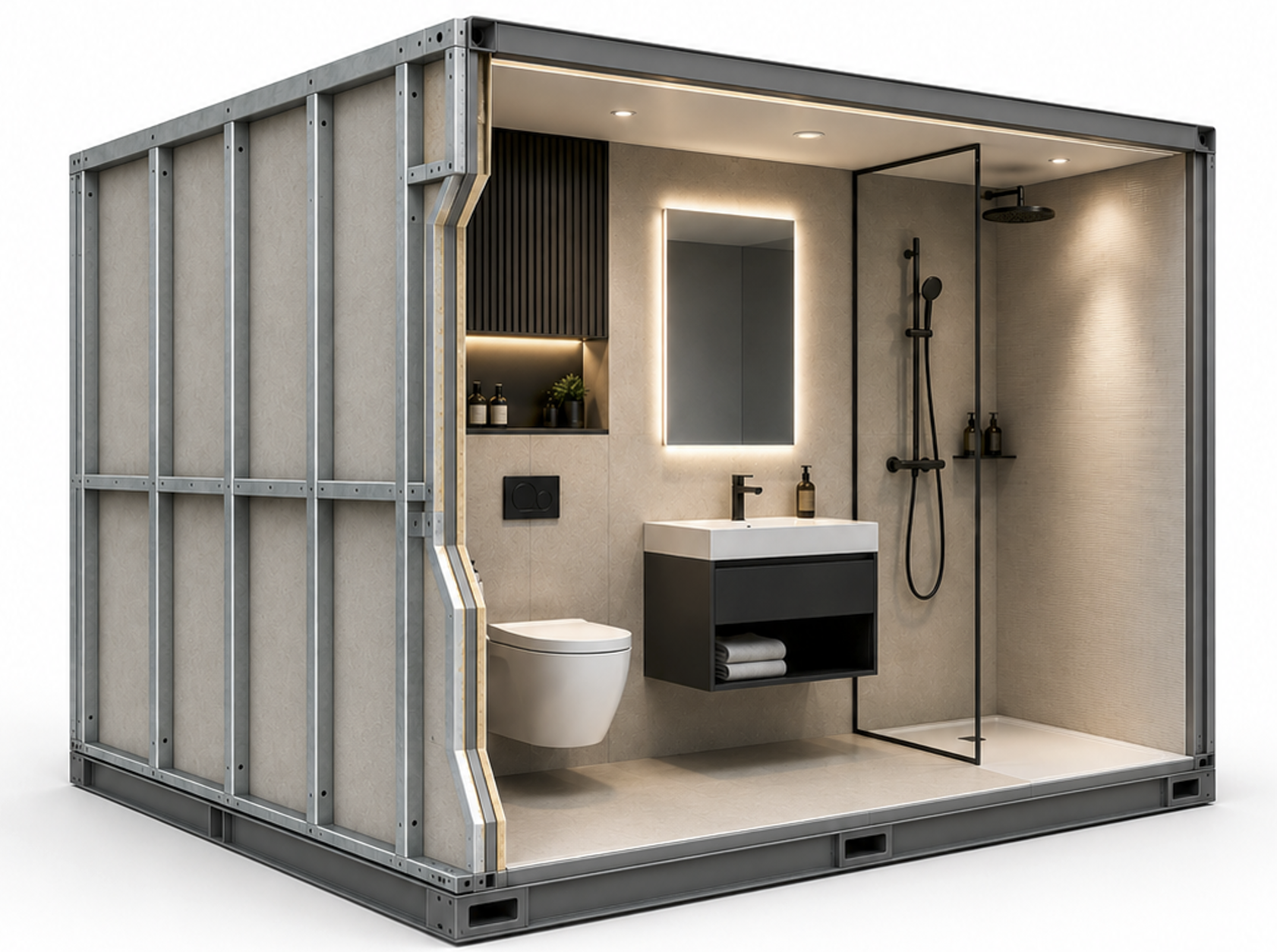
Seamless vs Panelised GRP bathroom pods
GRP bathroom pods can look similar from the outside. How the waterproof enclosure is manufactured — moulded as one continuous structure, or assembled from separate components — changes the whole-life performance of the bathroom.
Introduction
GRP bathroom pods may appear similar from the outside, but the way the waterproof enclosure is manufactured can be fundamentally different.
A Walker Modular Seamless Bathroom Pod is manufactured as one continuous moulded waterproof enclosure. A Panelised GRP pod is created by assembling separate manufactured components and then making the resulting junctions watertight. The difference is therefore not simply GRP versus GRP — it is Seamless manufacture versus an assembled waterproof enclosure.
The material may be similar. The construction philosophy is not.
Glass reinforced plastic is an excellent bathroom material: durable, impact tolerant, easy to clean and stable in a wet environment. Two pods can be made from broadly comparable materials and still be built on completely different engineering principles.
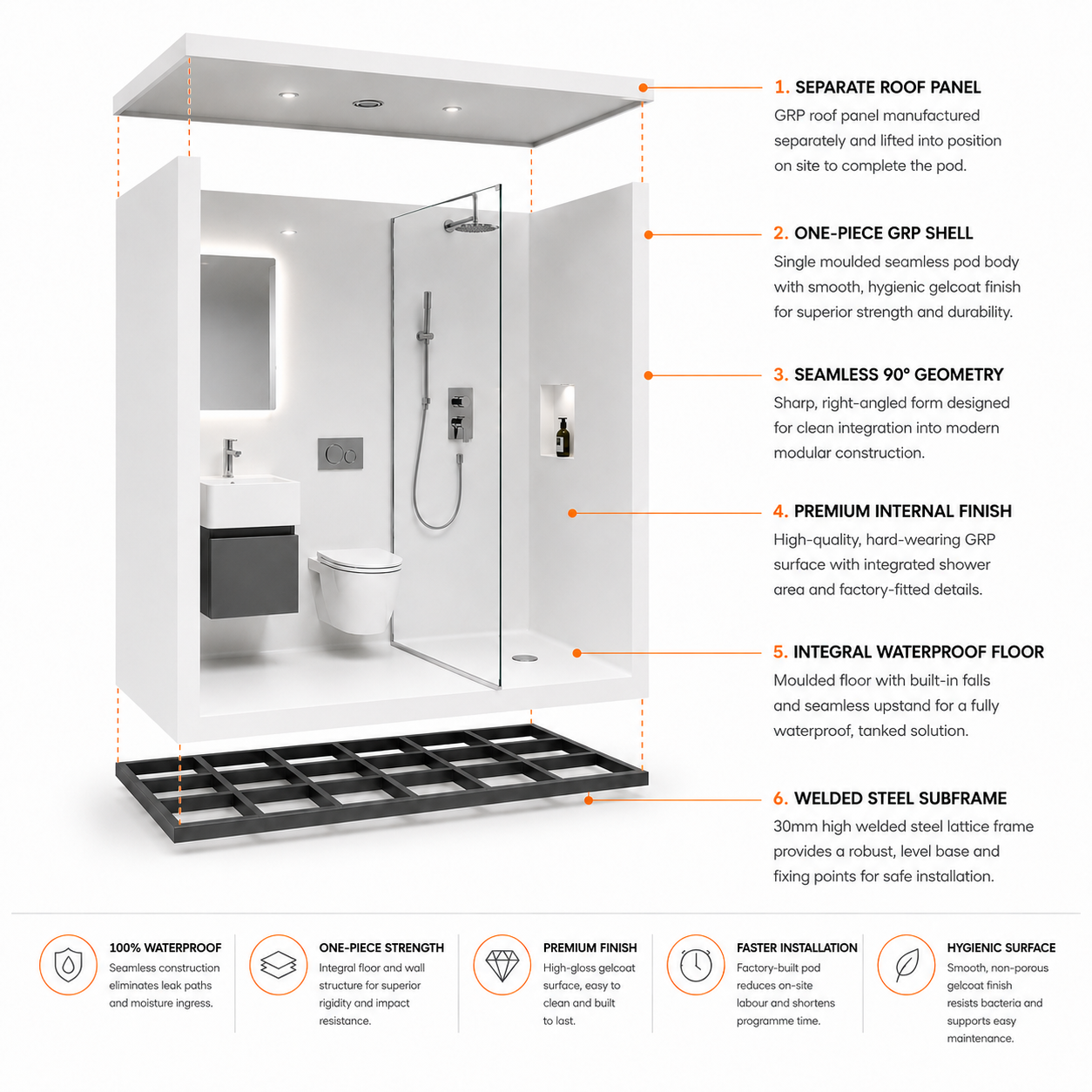
In a Walker Modular Seamless Bathroom Pod the principal waterproof enclosure — the floor, walls, shower area and wet-area geometry — is moulded together as one continuous structure. Where applicable to a particular Walker design, bath-related wet-area geometry may also form part of that continuous moulding. There are no separate GRP wall panels to assemble to create the principal waterproof enclosure, no panel-to-panel waterproofing joints within that enclosure, and no separate wall-to-floor panel junction.
Seamless by design. No assembled wall panels. No panel-to-panel waterproofing joints.
When Walker Modular describes a Seamless Bathroom Pod, we mean the principal moulded waterproof enclosure: the floor, walls and wet-area geometry manufactured as one continuous structure. Fixtures, fittings and service penetrations are detailed separately as part of the finished bathroom.
From marine engineering to residential bathrooms
Walker Modular's Seamless Bathroom Pod system is derived from marine-style composite construction principles, where continuity of the enclosure and the reduction of unnecessary joints are fundamental to watertight performance. Walker Modular adapted that philosophy for residential and large-scale bathroom manufacture.
The lineage is a way of thinking rather than a product claim: build the enclosure as a continuous composite structure, minimise the number of joints, protect watertight integrity as a whole, and design the detail out wherever the manufacturing method allows it.
One enclosure or multiple components?
Walker Modular Seamless Bathroom Pod
- The principal waterproof enclosure is one continuous moulded GRP structure
- Walls and floor are not separate waterproof panels brought together
- Wet-area geometry is integrated into the moulding
- Internal corners are moulded pencil-radius transitions
- No panel-to-panel waterproofing joints within the enclosure
- No separate wall-to-floor panel joint
- Seamless Bathroom Pods. Leak-free for life.
Panelised GRP
- Separately moulded panels and components are assembled together
- Some Panelised GRP systems can comprise up to eight separate components
- Each component creates edges and junctions
- Those interfaces must be sealed, bonded, gasketed or otherwise made watertight
- Some Panelised GRP configurations can incorporate up to approximately 40 metres of component junctions within a single bathroom
Seamless Bathroom Pod
- One continuous moulded waterproof enclosure
- No assembled GRP wall panels
- No panel-to-panel waterproofing joints
- No separate wall-to-floor panel joint
- Moulded pencil-radius internal transitions
- Leak-free for life
Panelised GRP
- Multiple separately manufactured components
- Up to 8 components in some systems
- Potentially up to approximately 40 metres of component junctions
- Junctions must remain watertight
- Interfaces must continue performing throughout transport, installation and occupation
- Maintenance-sensitive junctions become part of the building lifecycle
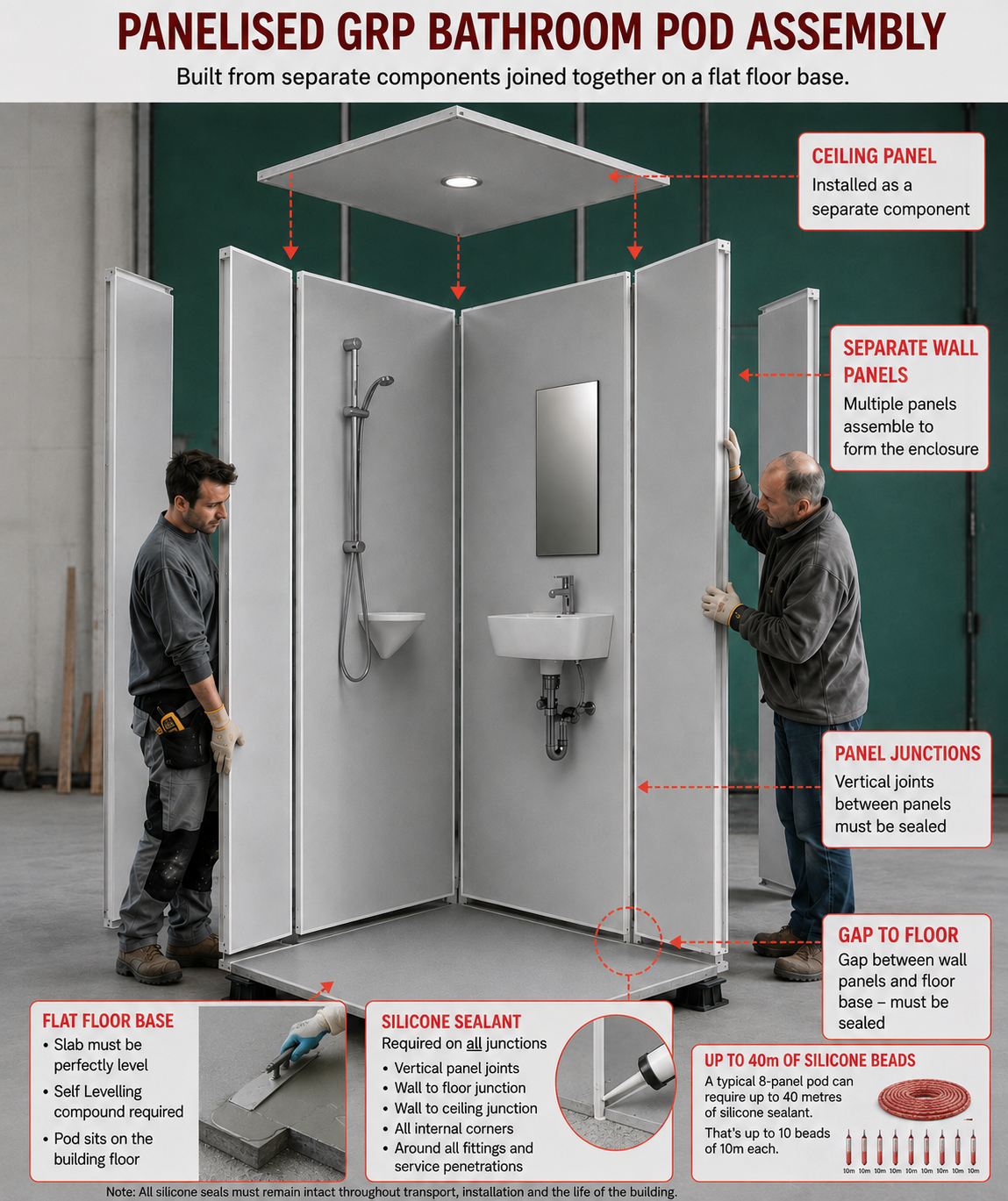
The important consideration is not simply how the enclosure is assembled in the factory, but how every one of those junctions continues to perform through transport, installation and the life of the building.
The safest waterproofing interface is often the one that does not exist.
A moulded pencil radius is not a sealed corner
Internal corners are frequently discussed in bathroom pod specification, and the language can blur two very different things. A Walker Modular pencil-radius corner is part of the continuous moulding. It is formed geometry, not a bead of silicone used to join two separate GRP wall panels.
Square walls do not require a Panelised enclosure. Precision moulding can deliver controlled, visually square geometry while retaining a small moulded internal radius, which is easier to clean and avoids a hard junction line in the wettest part of the room.
| Moulded corner | Panelised corner |
|---|---|
| Continuous GRP geometry | Separate components meet |
| Formed in the mould | Formed at assembly |
| No panel junction | Junction must be sealed or bonded |
| Nothing applied to maintain | Applied seal must be maintained |
The real question is simple: what creates the corner, and what is maintaining its waterproof integrity?
The bathroom still has to reach the building
A Panelised pod may leave the factory completely watertight. Factory testing is a genuine and valuable control. But the bathroom's working life begins afterwards.
A successful factory water test demonstrates the condition of the pod at that point in time. A Panelised enclosure must then maintain the integrity of every sealed junction through transportation, handling, installation and occupation.
Between the test bay and the finished building, a pod typically undergoes:
- Internal handling within the factory
- Lifting and loading
- Road transport
- Unloading and site movement
- Positioning, supporting, and setting to line and level
- Commissioning
- Normal building movement over the life of the structure
Movement, vibration, handling, changes in support and misalignment can introduce stresses into assembled structures and their interfaces. This is not a claim that every Panelised pod is damaged in transit — it is a statement of where engineering risk sits. Every interface that exists is an interface that has to survive the journey.
What happens if the supporting floor is not sufficiently flat and level?
A Panelised pod relies on separately assembled components maintaining their intended geometry. If the supporting substrate is outside the manufacturer's required flatness or level tolerances, loads and distortion can be transferred through the structure and its sealed interfaces. That can place stress on the junctions and potentially compromise waterproof integrity.
Does the system require a self-levelled or specially prepared floor?
Requirements vary by system. Some Panelised systems may require screeding, self-levelling, additional substrate preparation or tighter flatness and level tolerances than the surrounding structure would otherwise need. Buyers should obtain the exact installation requirements in writing before procurement.
Is that floor preparation included in the pod price?
Not necessarily. Additional screeding, self-levelling or substrate preparation can become another site operation, another programme activity, another trade interface and another project cost. Total installed cost should therefore be compared, not simply pod supply price.
Sealant is a maintenance component
Panelised systems may depend on silicone, adhesives, bonded seals, gaskets or other applied sealing systems at component junctions. These are legitimate engineering materials used across construction every day. They are also serviceable materials with a finite life.
In a bathroom, those interfaces are exposed over time to:
- Moisture and steam
- Repeated cleaning and abrasion
- Cleaning chemicals
- Movement
- Temperature change
- Continuous occupancy
- Material ageing
Over time, bathroom silicone can discolour, blacken, become difficult to clean, lose adhesion, require repair and eventually require renewal. The timescale varies with product, workmanship, exposure and cleaning regime — but the principle does not.
Where waterproofing depends upon an applied seal, that seal becomes part of the building's maintenance strategy.
Panelised construction can build maintenance into the bathroom from day one. Seamless construction designs many of those maintenance points out.
Water escape is a lifecycle issue
If a waterproof interface in an assembled Panelised system loses integrity, it can create a pathway for water escape. Contributing factors can include:
- Deterioration of the sealing material
- Loss of adhesion
- Movement across the junction
- Physical damage
- Installation stress
- Substrate movement
- Degraded or previously repaired sealing material
Every waterproof interface has to continue performing. A panel joint that does not exist cannot become a panel-joint water-escape pathway.
Fewer interfaces. Fewer maintenance points. Fewer potential water-escape pathways.
The scale question
A single junction is a detail. The same detail repeated across a building is an asset-management position. Where a Panelised configuration contains approximately 40 metres of component junctions per pod, the arithmetic across a large scheme is straightforward:
Up to 40 km of junctions across 1,000 bathrooms.
1,000 bathrooms × 40 metres = up to approximately 40 kilometres of component junctions. How much of that do you want to inspect, clean, maintain and potentially renew over the life of the building?
The purchase price is not the lifetime cost
Whole-life cost is not simply what the pod costs to buy. It is what the bathroom costs to own.
Potential lifetime cost can include:
- Substrate preparation
- Inspection regimes
- Cleaning
- Seal replacement
- Maintenance labour and supervision
- Access to occupied rooms
- Curing time before a room can be returned to use
- Room downtime
- Resident or guest disruption
- Water-damage remediation if water escape occurs
A detail repeated thousands of times becomes an asset-management issue.
That matters most where bathrooms are numerous, heavily used and expensive to take out of service: hotels, PBSA, Build to Rent, residential operators and institutional owners. In those settings the cost of a maintenance event is rarely the cost of the material.
Hygiene, appearance and odour
Exposed bathroom sealants can become stained, discoloured, blackened and harder to clean as they age. Where moisture and organic residue accumulate around deteriorated or difficult-to-clean joints, this can contribute to microbial growth, hygiene concerns, unpleasant odours and increased cleaning requirements.
A moulded GRP surface with continuous geometry and moulded internal radii presents fewer places for residue to collect and fewer applied materials whose cleanability changes over time.
These questions are not about any particular manufacturer. They are the practical points a buyer may not have considered when comparing systems.
FAQ
Questions to ask before specifying Panelised GRP.
How many separate components make up the waterproof enclosure?
Some Panelised GRP systems can comprise up to eight separate components. Every additional component creates edges and junctions that must be joined and kept watertight.
How many metres of joints can there be in one Panelised bathroom pod?
Depending on the configuration, some Panelised GRP systems can incorporate up to approximately 40 metres of component junctions within a single bathroom. Buyers should ask for the actual joint length in the system being considered.
What keeps those junctions watertight?
Ask exactly what is used at wall-to-wall and wall-to-floor junctions: silicone, adhesives, bonded seals, gaskets or another method. If the waterproof enclosure depends on those materials, their long-term condition matters.
What happens to those joints during transport and handling?
A pod still has to be lifted, loaded, transported, unloaded and moved around site after factory testing. Those operations introduce movement and vibration, and the sealed interfaces must remain intact throughout.
Can final positioning and levelling put stress on panels and joints?
Yes, potentially. A Panelised structure relies on its separate components maintaining their intended geometry. Changes in support, alignment or level can introduce stresses through the structure and its interfaces.
What happens if the supporting floor is not sufficiently flat and level?
If the substrate is outside the manufacturer's required tolerances, stresses can be transferred through the Panelised structure and its sealed junctions, potentially compromising waterproof integrity.
Does a Panelised pod require a self-levelled or specially prepared floor?
Requirements vary by system. Some Panelised systems may require additional screeding, self-levelling or substrate preparation to achieve installation tolerances. Buyers should obtain the exact requirement before procurement.
Is that floor preparation included in the pod price?
Not necessarily. Floor preparation can be a separate site operation and additional cost. It should therefore be included when comparing total installed cost rather than pod supply price alone.
Can a Panelised pod pass its factory water test and later develop a water-escape pathway?
A successful factory test confirms the condition of the pod at that moment. Transport, handling, installation, levelling and years of use occur afterwards. Every sealed interface still has to retain its integrity throughout those stages.
What happens to silicone and other seals as the bathroom gets older?
Sealants in wet environments are exposed to moisture, cleaning chemicals, movement, abrasion and ageing. Over time they can discolour, blacken, lose adhesion or require repair and eventual renewal.
Who is responsible for maintaining and renewing the joints?
Once the building is operational, inspection, cleaning, repair and eventual renewal of maintenance-sensitive joints can become an owner or operator responsibility. Across hundreds or thousands of bathrooms, this can become a significant maintenance programme.
Can deteriorated joints create hygiene or odour issues?
Where sealant becomes degraded or difficult to clean, moisture and residue can accumulate around the joint. This can contribute to staining, microbial growth, hygiene concerns and unpleasant odours.
Is the lowest pod purchase price necessarily the lowest lifetime cost?
No. Whole-life cost can also include substrate preparation, inspection, maintenance, seal replacement, room access, labour, potential downtime and remediation if water escape occurs.
What happens if joint maintenance is delayed?
Deterioration does not improve by itself. Delayed inspection or renewal can increase the potential for staining, hygiene issues, loss of seal integrity and water escape, potentially turning planned maintenance into more disruptive remedial work.
What does this mean across hundreds or thousands of bathrooms?
Small maintenance tasks become significant when repeated at scale. If a configuration contains approximately 40 metres of junctions per pod, 1,000 bathrooms could represent up to approximately 40 kilometres of interfaces requiring long-term consideration.
A Panelised bathroom is not just something you purchase. Its joints and interfaces are something you inherit.
The Seamless alternative
Walker Modular takes a fundamentally different approach. The principal waterproof enclosure is manufactured as one continuous moulded structure.
- No assembled GRP wall panels
- No panel-to-panel waterproofing joints
- No separate wall-to-floor panel joint within the moulded enclosure
- Moulded pencil-radius internal transitions
- Marine-style composite construction principles adapted for residential bathroom manufacture
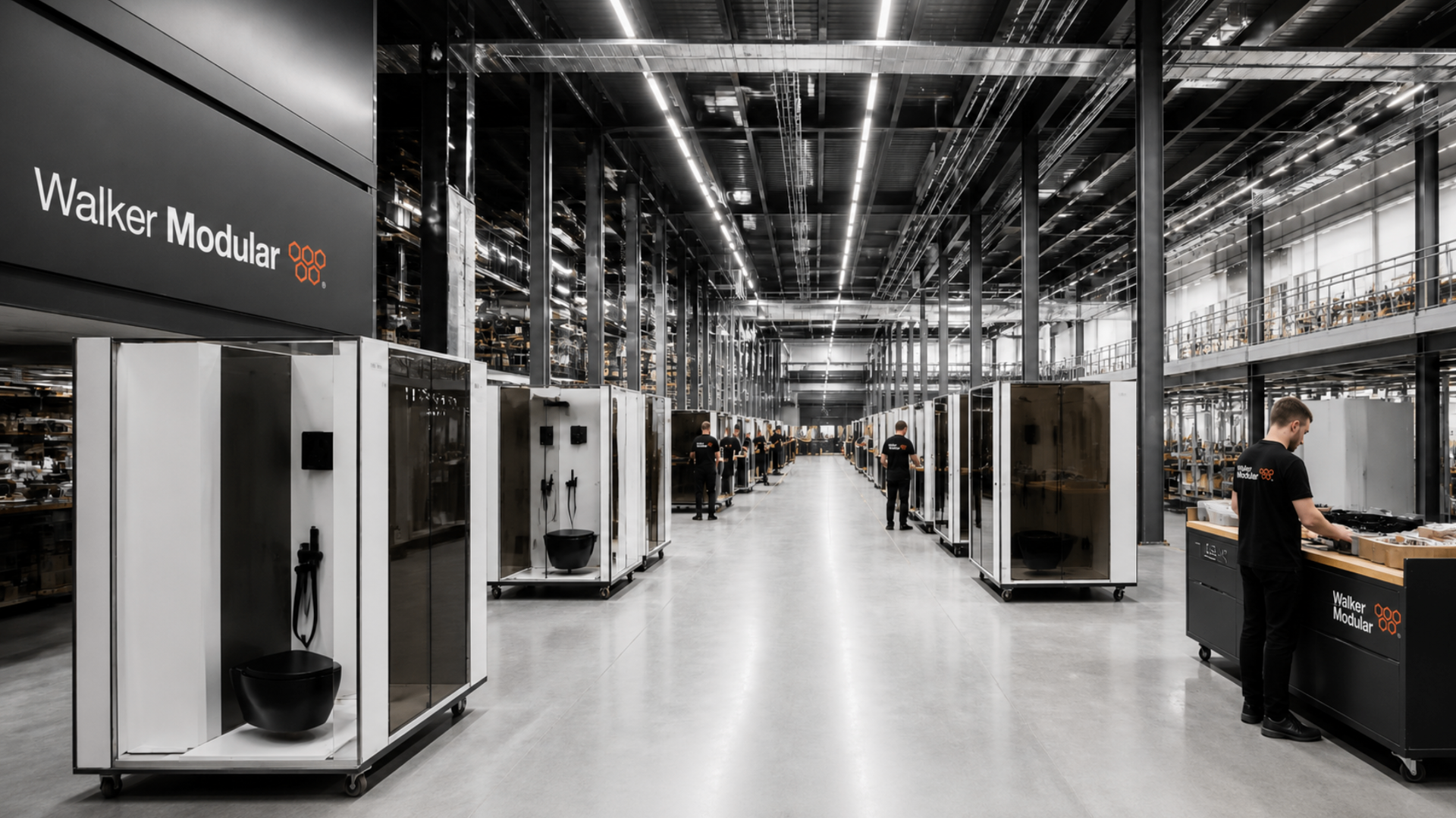
Seamless Bathroom Pods. Leak-free for life.
Why build waterproofing interfaces into the bathroom when you can design them out?
How many waterproofing interfaces do you want to own, inspect and maintain for the life of your building?